How To Get Hooked on Haiku

“What changed?”, I asked myself as I lay in the near scorching water.

(I do my best thinking in the bath and Wednesday night was no exception!)

“How did I get so hooked on Haiku?”

Here the things, I’ve been writing haiku on and off for about a year, which let’s be fair is not that long. Especially when you consider that there have been more than a few gaps along the way.

But since March (2021) I’ve kicked my writing up a gear. So much so that I’ve even managed to get a few verses published – something I never even dreamed possible.

“How did the things happen?” I wanted – no, I needed to know. Because if I could quantify some factors then I could double down on them over the coming months.

Three things floated up through the bubbles. Three changes I made that helped me get serious about haiku.

Three things that can help you get hooked on haiku too!

Just Do It!

When Nike launched the ‘Just Do It’ campaign in 1988 they hit advertising gold. And let’s face it, they’ve been raking in the cash ever since.

Think what you want about the company, but there is a lot of wisdom in that strapline. After all, there comes a point where you need to commit and just do it. Whatever ‘it’ is, right?

Photo by Olya Kobruseva on Pexels.com

In my case ‘it’ was developing a haiku writing habit.

Back at the start of March, I decided I would write one haiku, every day. No matter whether I felt like it or how busy I thought I was.

And I’ve stuck at it. Writing each one next to the day’s date in a gridline exercise book.

Sure, I’ve missed a few days here and there but I made up for it along the way.

Because over the last three months, I’ve written almost 250 haiku.

I hadn’t even written that many in the previous 9 months combined!

And here’s why. Before March I would wait around for inspiration to come knocking. But more often than not inspiration had better things to do than hang out with me.

But when you focus on writing on verse every day no matter what things change. After a while you find your haiku writing no longer depends on whether you feel inspired or not. Because it isn’t dependant on fickle inspiration anymore.

Now it depends on cold, hard habit. Which as Octavia E. Butler said, is far more dependable.

Habit doesn’t care whether your work is good or bad. It only cares whether you do it. And do it often.

Look, haiku poems might be an art form. But writing haiku is a skill. And like all skills, it depends on habit.

Make a habit of practising every day and you soon notice an improvement. It’s been true for me. It can be for you too!

Have you committed to forming a daily writing habit? What is stopping you?

If you struggle to form habits why not use a tracking app? I use Streaks

Read Everything

When I was 16 I decided to learn the bass. I’d always been into music. But now I listened to music in a different way.

I started searching out bands with talented bass players. I brought their albums and gorged myself on them.

The more I listened the more I learnt about what my instrument could do. The more I learnt, the more determined I became to improve.

In the same way, the more I read haiku, the more I learn about what this amazing poetry can do. The more I learnt, the more determined I became to improve.

Over the last three months, I have read anything and everything I could get my hands on. And I want to encourage you to do the same.

Photo by Taryn Elliott on Pexels.com

To read the classics like Basho, Buson, and Shiki. To read the American greats like Richard Wright and Jack Kerouac. To engage with modern haiku through anthologies, podcasts, and journals.

But do it with intention. Read to enjoy, of course, but also to learn!

As you peruse haiku, try to get into the poet’s head. Try to understand how they see the world, craft images, and arrange idea.

When you find a haiku that impacts you. Highlight it and add a quick note about why it has had an impact on you. You could even try an write a verse that imitates the style.

Be a haiku magpie, gathering up all the shiny verses that can help you improve your craft.

Austin Kleon calls this learning to ‘Steal like an Artist’ (Amazon UK | Amazon US). And I’ve found this particularly helpful.

At this point, you are thinking, “Liam, I don’t have that kind of time.” I never would have thought I did either. I am a full-time working, an active family man with two young boys and a wife.

The truth is that haiku writing is important to me. And so I make time to learn from others. A kindle and love taking baths help too!

So whatever you do to find the time, read any and every haiku book you can.

The more you do, the more you’ll grow in what you can do. I know I have.

What Haiku book are you reading now? What have you read? What will you read next? Let me know in the comments.

If you don’t know where to start, check out the new ‘on my bookshelf’ page{Link}.

Get Out More!

I’ve worked from home for over 10 years. And you know what I love it. I can get more done with only my Pomodoro timer for the company than I ever could in a traditional office.

But working from home isn’t for everyone. And I won’t lie, it has some downsides.

For one I find it hard to get out outside. This is ironic considering I manage my own time.

If I don’t make a concerted effort then the only time I might leave the house is for the school run.

Photo by Kaique Rocha on Pexels.com

When that happens not only does my mental well-being suffer. But my haiku writing suffers too.

That should surprise you, right? I mean haiku poetry most often use images and ideas from nature. But it is hard to draw inspiration from nature if you don’t spend any time in it, right?

So recently I’ve made a concerted effort to spend more time outside the house.

And surprise, surprise, I find it much easier to write haiku! Not to mention the improvement in my mood, which also aids creativity.

Again this doesn’t have to be a huge time commitment. Who has time for hours of hiking on a weekday?

No, instead, I tend to combine time outside with things I am already doing. Like doing take my coffee/lunch breaks in the garden. Even if it means wearing a coat, scarf, and gloves!

I’ll do the school run on a bicycle rather than in the car. Or I’ll wait until the children are in bed and go for a half an hour walk around the neighbourhood. Sometimes, all I’ll do is find a bench and watch the world go by.

Whatever it is, the goal is to do it with a mindful focus on the world all around. To be present in that moment. No checking the phone. No thinking about work tasks or house chores.

Like me, you might find the beginnings of a haiku will come to you there and then. If so, you can a moment to finish it there and then or jot it down for later.

If not, when you sit down to write later you now have a host of sights, sounds, and smells you can draw on from.

There is no way I would have been able to write almost 250 haiku without making time to get out more. Even if only to drink a cup of coffee.

Do you need to get more? How can you combine time outside with things you already do?

The Takeaway Box

The last three months have been a wild ride. I’ve gone from paddling in the haiku shallows to jumping into the deep end.

There is no denying it – I am hooked on haiku!

Looking back, there are three key factors that contributed to this. Three things that you could take away and put in place for yourself:

  1. Learn to just do it by creating a daily haiku writing habit.
  2. Read everything and anything about haiku you can get your hands on.
  3. Make an effort to get out more into the world. For your own good as well as your poetry.

Remember, this blog by an amateur for amateurs. So if you’ve found a trick or tip that’s helped you, let me know in the comments.

Likewise, if you’ve recently got hooked on haiku. Let me know.

I’d love to hear from you.

Photo by Michelle Leman on Pexels.com

Be Right Back

A quick post to say that no, this blog has not suddenly died. *phew*

I’ve got some personal stuff going on at the moment which has somewhat disrupted my posting schedule. But I’ve got more great material planned for the coming weeks.

So watch this space, becuase I’ll be right back!

Photo by Peng Louis on Pexels.com

3 Killer Tips from ‘The Way of Tanka’

Tanka? That’s just a long haiku, right? Wrong!

I first learnt about tanka’s existence whilst reading ‘How To Haiku’ by Bruce Ross (Click here for my review). At the time, and perhaps because of the context, I assumed that it was long-form haiku.

In English, tanka is often presented as five lines. And in Japanese, tanka was traditionally written in 31 on (or sound units), broken up into sections of 5, 7, 5, 7, 7. So you can see the similarities. Haiku is written in three lines in English, and traditionally contains three units of 5, 7, 5 on in Japanese.

And so I filed tanka away in my ‘Meh, one day’ draw and went back to writing and reading about haiku.

That was until some folks on Twitter (particularly @Eve_Castle and @SabineWeissM) started promoting the #NaTankMo hashtag. Which, in turn, reignited my interest in tanka.

I realised immediately that A. I may have misjudged this form of poetry. And B. I knew next to nothing about it. So, I did want I always do in these situations. I brought a book.

And so I began reading ‘The Way of Tanka’ by Naomi Beth Wakin (Amazon US).

I’m only partway through. But, I am learning tons. Like how tanka predates haiku by over 1000 years! And how it allows more freedom for self-expression than its reserved little brother.

I can’t offer you a full review… yet. But in the spirit of this blog, I wanted to share with you three killer tips I’ve picked up so far.

Here they are:

1. Forget about syllables

Naomi addresses the issue of syllables early on in the book. Must a tanka contain 31 syllables to be a true tanka? Wakin answers: no.

There are some technical reasons for this. Such as how the sounds (on) that make up Japanese words don’t have a 1:1 correlation to English syllables.

And instead, she recommends you forget syllables and instead focus on a short, long, short, long, long verse pattern. If you must have a number, Wakin offers the 19 – 31 as a general guide.

This is because, for Naomi, what matters is not numbers but strong images. Reminding us, through a quote from Michael Dylan Welch, that “It’s the poetry that counts.”

We haiku lovers could learn a lesson here too. Writing these Japanese short forms is not about maths and formulas. But about communicating powerful images, ideas, observations, and experiences.

I’ll admit, Wakin has challenged me to worry less about line counts and more about the poetry itself. What about you?

2. Create a powerful pivot

Tanka often consists of two parts or images. Here’s an example from the book:

In a velvet box 
her strand of pearls 
still broken 
a promise he made 
when they were young 
~ Susan Constable (p72)

Do you see the division? How about now?

In a velvet box
her strand of pearls
still broken

a promise he made
when they were young

The tanka breaks down into two strong images. With one giving context or commentary on the other and vice versa.

But, Naomi Beth Wakin says there is more to writing tanka than plonking two images side by side. This is why she suggests that the third line should act as a ‘pivot’ linking the two images.

I’ll let Naomi explain it in her own words:

The pivot line is usually the third of the five lines, and its function is to link the outer image, whatever has alerted the the tanka poet, to his or her inner thoughts and emotions that have arisen from the image. In other words, the pivot is between the emotion and what caused the emotion.

Wakin, The Way of Tanka (2017), 30

In the Susan Constable verse above, the pivot is ‘still broken’. This phrase links the description of the ‘strand of pearls’ in lines 1 & 2 with the broken promise in lines 4 & 5.

It acts as a bridge that takes the reader from observation to emotion and back again.

It took me a while to grasp this concept, but it has helped me to arrange my lines with more intention. Which in turn has produced better tanka.

What other benefits are there in having a strong pivot line?

Tanka isn’t just two images slapped together. This minimalist poetry requires thought, planning, and intention.

3. End with a flourish!

Finally, Wakin encourages budding poets to ensure that their tanka has a strong end.

Naomi admits that this is a personal preference, but I can see the logic. The final line does (or at least should) leave a lasting impression on the reader.

After all, a gymnast can pull of the most complex routine. But what does it matter if they can’t finish well?

In the same way, we’re encouraged to ensure that we ‘stick the landing’ in our tanka poems:

As a reader coming to the end of tanka, I ask to be surprised, shifted, or least captured with some moment of interest or some moment of questioning. I don’t want my response to be: “So what?” A strong last line can help achieve what I am looking for.

Wakin, The Way of Tanka (2017), 36

So what does a strong last line look like? Let’s look at Susan Constable’s tanka again. And this time pay particular attention to the last line:

In a velvet box 
her strand of pearls 
still broken 
a promise he made 
when they were young 

Now, reread it. But change the final line to “sometime last week”. Still as impactful? Hardly!

The line “when they were young” increases the significance of “her strand of pearls”. If she has kept hold of them all these years, they must be precious for her.

But the final line also strengthens the impact of the ‘broken promise’ image. It causes you to empathise with the author. Feeling some of the sadness and disappointment she feels every time she opens the velvet box.

This focus on the final line is a reminder that tanka isn’t just two images slapped together. This minimalist poetry requires thought, planning, and intention.

Like haiku, you have to learn the skill and craft involved to master this art form. And that only comes with practice!

How important do you think the last line is to a successful tanka?

Taking Time to Tanka

I’m enjoying reading The Way of Tanka. Though I’ll hold fire on a recommendation until I’ve finished it.

That said, so far the book has helped me explore the world of tanka poetry further. I’ve also enjoyed writing some tanka myself.

(I’ve spared you them here. But feel free to check my Twitter if you want to see my fumbling attempts.)

Whether I carry on when May is over… who knows? I am, after all, a haiku man.

That said, I have enjoyed learning something new. The challenge of a different but related form of poetry. The discipline of doing it daily. And applying the advice from the book.

Do you write tanka? What do you think of Naomi Beth Wakin’s advice?

If you don’t, can you apply any of these principles to your own writing? In what ways?

Resources

Looking to get started in Tanka? Try this quick start guide by Jeanne Emrich.

Looking for something to stretch you? Try these ten tanka techniques. (My thanks to Twitter follower @SabineWeissM for the link).

For more tanka resources, try here.

And finally, here’s the link again to The Way of Tanka by Naomi Beth Wakin (Amazon US)

3 Ways to Describe Something Without Naming It (Let’s Talk Haiku!)

Would a rose by any other name still smell as sweet? It might if the poet used the techniques we’ll look at today.

Because in this edition of Let’s Talk Haiku, I’ll show you how three brilliant haiku poets describe something without naming it. And then I’ll explain how you can do it too.

Ready? Let’s talk haiku!


Engage Your Readers Emotions

Good writing is like a taxi. It takes you somewhere. Great writing is like a Ferrari. It too takes you somewhere, but it does it in style!

One way you can take your reader on a memorable journey is by engaging their emotions. Something, James Welsh’s haiku does so well:

Memories framed
Scattered across the walls
The house - empty.

~ James Welsh (@JamesWelsh35)

Notice what’s described in lines one and two. Photos, right? James never mentions the word ‘photograph’ at any point in his verse. But then doesn’t need to.

And here’s why. The first two words (‘Memories framed’) are not just a neat way to use four syllables (which they are!). They also lead you to the physical and emotional idea of a photograph head without ever having to use the word.

Now, do you see how the second line develops the first? ‘Scattered’ usually brings to mind something messy. But not here. Instead, in James’ verse it implies a multitude. You imagine a space with countless memories captured and displayed ‘across the walls’.

Take your reader on a memorable journey by engaging their emotions.

But the journey is not over yet. The simple phrase, ‘The house’ expands the scope of the verse. Suddenly, we’ve moved from a close up shot (‘walls’ and photos) to a wide angle lens (‘the house’). You expect more detail but it doesn’t come.

Instead, we get a ‘-‘ which functions as a Kireji (切れ字) or “cutting word”. The idea here is that by breaking the image you create a pause. A pauses that can help set up a contrast, build tension, or, in this case… both.

All this leads to the twist at the end of final line. A twist that hits the reader hard!

The house, which is full of memories, is empty of people. There no one’s home. The family that hung these photographs are gone, either moved on or died. All that remains now, are the lifeless snapshots of what came before.

This haiku gets you to connect with an image you can relate to (Photos of precious moments hung on the wall). It then uses this emotional connection to increases the impact of the final image: An empty house.

James has taken us somewhere, but he’s done it in style! In what ways might you be able to connect with your readers emotion through haiku?

Photo by Rachel Claire on Pexels.com

Describe What You Hear

Pop. Clunk. Gulp. Splash. Honk. Glug. Vroom. Words like these drip with descriptive energy. They come in all shapes and sizes: nouns; adjectives; verbs… but they all have this in common. They sound like the thing they are describing.

The ten-dollar word for this is onomatopoeia. And it is something Rhys Angulatta’s verse does brilliantly:

Click click click click, ding!
A bygone relic restored.
A new chapter starts.

~ Rhys Angulatta (@RhysAngulatta)

The first line kicks off this haiku with a ton of pace. But that’s not all it does.

Notice, that Rhys never needs to mention the word typewriter. By the time you get to the end of the first line, you already have the picture in your head. Someone tapping away at the keys until the carriage goes ‘ping!’

Now that the first verse has implied the object, the next two verses can explain the significance of the object.

The first thing we learn is that this is a vintage typewriter. An antique. But describing it as a ‘bygone relic’ might also mean that the typewriter was more than old.

Maybe it was also something once considered no longer necessary. Obsolete. Destined to be replaced by a newer model or an early word processor.

If that’s true, then this ancient typewriter was not only restored physically. Repaired and return to full working order. But also restored functionally.

Think about it. Whilst some today treat vintage typewriters the way my parents treat decorative plates. A typewriter is a practical object. A writing tool. As an instrument of creativity.

And I happen to know that this is exactly how Rhys and his wife intend to use their new typewriter.

Next time your haiku is needs energy, ask yourself: Can I describe something in his verse using only what I can hear?

All this adds to the weight of the final line. A ‘new chapter’ has began not only for the author as he gets to grips with his gadget. But also for the typewriter. Once left to rot; now ready to fulfil it’s purpose in life.

Rhys’ haiku uses ‘sound words’ (onomatopoeia) to put the idea typewriter in your head. And in doing sets up the rest of his verse. All carried off with energy and fun!

Don’t believe me, try this: take out the first line and replace it with ‘A vintage typewriter’. Bye-bye, energy. Bye-bye, fun. Hello, boring!

So, next time your haiku needs energy, ask yourself: Can I describe something in his verse using only what I can hear?

Photo by Rhys Angulatta.

Make It More Human… Literally!

Grab your coat.  We’re heading outside for this last example:

honeybee pilgrims
at the garden shrines 
- chanting 

~ Steve Joseph (@Steve_Joseph37)

Notice the way Steve Joseph describes the bees. He could have said, ‘worker honeybees, at the garden flowers, buzzing’. But let’s face it. That’s about as exciting as staring at a magnolia wall!

Instead, Steve gives human qualities to non-human creatures. Honeybees become chanting pilgrims. Flowers their religious shrines. Oh, and they’re not buzzing! They’re chanting. It’s clever, right?

The name for this technique is ‘anthropomorphism’. And it’s a great way to increase the depth, detail, and playfulness of a haiku without adding more words.

“Take an ordinary moment and make it extraordinary by giving human feelings, actions and qualities to non-human objects.”

Now, rather than what could have been a bland, rather stilted sentence about bees. Steve has instead invited us to witness a vibrant, exciting religious festival!

Bright and colourful shrines have been set up everywhere you look. Faithful pilgrims going from one to another. The air filled with the sound of their prayers. And it is all happening in the flower bed!

The verse is deep and descriptive. But it isn’t pretentious. It’s engaging and relatable. Inviting us to see and experience the wonder outside the window… It’s everything good haiku should be.

In fact, the anthropomorphism is developed so well in this verse, that by the end, you have to wonder… Is he watching bees in his garden at home and being reminded of chanting? Or is he watching bees whilst he can hear the chanting? At, say, a nearby temple?

Even now, I can’t decide. I thought about asking Steve outright but decided against it. For me, the enigma and mystery is as much a part of the haiku as the bees, flowers, and religious images.

And yet all Steve did was apply a few well chosen human qualities to non-human objects! But in doing so, he took an ordinary moment and made it extraordinary.

Anthropomorphism can be tricky to get right. But it is worth persisting. Because, when done well, it’s powerful and effective. As it is in this haiku.

Best of all, it works with more than insects and plants. Use it with trees, water, hills, mountains, cars, cats, technology, and more.

Experiment… see what happens!

What’s your favourite element of Steve’s verse? Why?

Photo by Lukas on Pexels.com

Takeaway Box

This week’s haiku were all describe an object or situation without naming it. There were James Welch’s photographs. Rhys Angulatta’s new old typewriter. And Steve Joseph’s honeybees.

But each writer had their own way of doing it:

  • James made an emotional connection with his readers.
  • Rhys invoked the sound of a typewriter in his writing (onomatopoeia).
  • Steve described honeybees as if they were humans (anthropomorphism)

These techniques, if used badly can be cheesy or pretensions. But used well, they powerful ways of taking your haiku (or any form of writing) to the next level.

  • Which was your favourite of the three haiku and why?
  • Pick one of these techniques (emotional connection, onomatopoeia, anthropomorphism). How could you use it in your own work this week?

Dear Readers.

I’ve made some changes in response to your feedback. Like a good whisky, Let’s Talk Haiku has been distilled and concentrated. Making it shorter, and more punchy!

What do you think of the new style? Let me know in the comments or tweet me: @RealLiamMag.


NB: All commentary is the writers own subjective thoughts and opinions and may not represent those of the original authors.


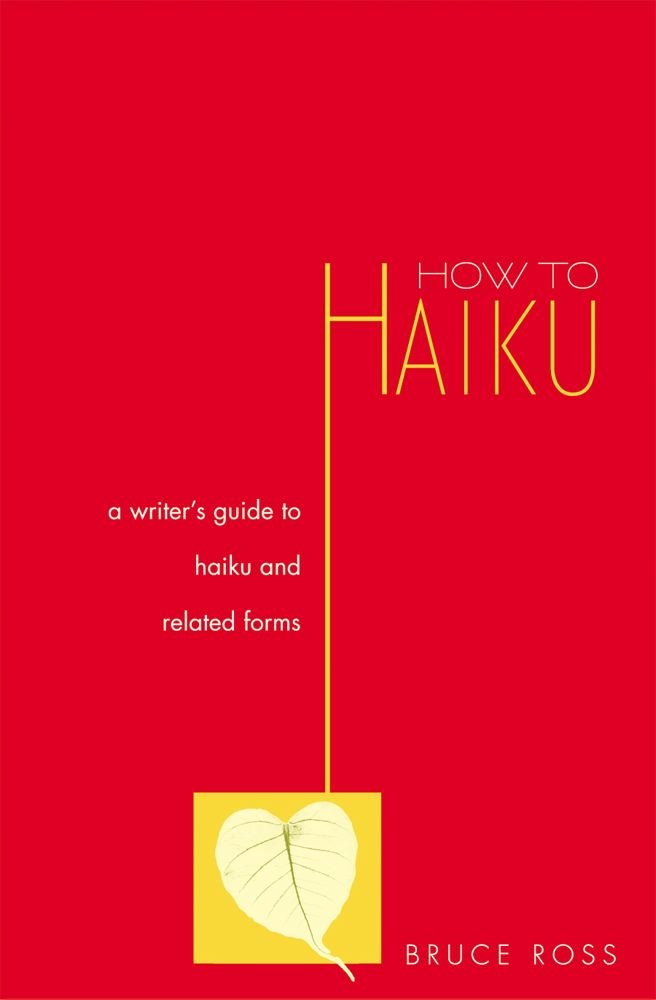
Should You Read ‘How to Haiku’ by Bruce Ross?

Save your hard learnt pennies by reading my review of haiku books. All laid out in a simple, easy to digest way.

⭐⭐⭐

Like a packet of Skittles, Bruce Ross’ How to Haiku: A Writer’s Guide to Haiku and Related Forms (2002), is a mixed bag. Let me explain.

What’s good?

Bruce’s book promises much and, on paper, has a lot going for it. Unlike other books in this range, this book takes also covers haiku’s brothers and sisters. Related forms like senryu, haibun, tanka, and others.

This is the book greatest strength. It offers a compact introduction to a whole family of Japanese poetry styles.

Image via Amazon

I never would have thought of writing a short piece of prose with a related haiku on my own. That was until I read the book’s section on haibun.

That is what is so great about this book. By describing other haiku-like styles of poetry, Bruce shows us what this kind of poetry can do.

And that is a good thing. Haiku is a wonderful way to do creative writing. Yes, it is restrictive, but that’s part of its power and appeal. By explaining these different forms, Ross adds tools to the haiku writers toolbox.

The tools help the writer to fit the form into the creative idea. Rather than the idea to the form. Which can sometimes lead to wooden or pretensions sounding haiku.

So, whatever you experience with haiku. This book is worth reading this book for that alone. Those wanting to dig deeper will find the ‘Further reading’ appendix particularly helpful.

What’s not so good?

I’m not what you’d call a ‘hands on’ guy. I can put up a shelf and build flatpack, but that is about my limit.

Don’t get me wrong. I know the difference between wood plane and power sander. I could even tell you when you might use one over the other. But use them correctly? That’s where I need some help.

And that’s my biggest complaint about How to Haiku. It doesn’t cover the nuts and bolts of writing haiku. Things like choosing a good idea, arranging images, experimenting with synonyms, using punctuation, or moving phrases around until they ‘fit’.

Photo by Ron Lach on Pexels.com

The book feels more like a genre guide than an actual ‘how to’ manual. Which is a shame.

Bruce also covers these different poetry styles in a (relatively) short space of time (186 pages). That’s commendable. But means the book ends up broad and, at times, lacking depth.

Sure, some stuff in the appendices that some readers might find helpful. Personally, I would have preferred it with one less chapter (perhaps Haiga). And except further reading, I could also live without the appendices.

Those changes would mean the remaining chapters expanded. This would allow room to address those practical nuts and bolts of writing the poems. But also space for writing exercises too.

Lastly, the kindle version of How to Haiku also includes some grammar/format errors. Whilst only occasional they are noticeable and distracting.

Should I buy this book?

Like a good greengrocer, there is no doubt Bruce Ross knows his onions. That alone makes this a good introduction to haiku-like poetry. And I can see myself coming back to it in future for a refresher or for inspiration to try new things.

But if you are looking for a book to guide you through the practical process of writing haiku. You may want to look elsewhere.

Have you read this book or found one that’s better?

Let me know in the comments or tweet me @RealLiamMag.

Let’s Talk Haiku! (2021/04/19)

In ‘Let’s Talk Haiku‘, I reflect on my favourite haiku drawn from the web, social media, books, and few of my own. This week’s theme is haiku and the human world. Enjoy.


I learnt a new word this week: honkadori (本歌取り). In Japanese poetry, a honkadori is a reference within a poem to a previous poem. It could be a word, phrase, or even an idea or theme. The intention being that the reader picks up on and recognise this allusion. This might seem strange if you live in the plagiarism and copyright obsessed West. But Haiku it seems has a long history of linking back to the poets of the past in new compositions. Keep that in mind as you read our first verse:

stillness ...
in the frog pond
rubbish

~ Carol Jones via Eric Liu (@StoryHaikuTanka)

It seems to me that Carol Jones is invoking a very specific haiku in the verse above. Perhaps, you know which one I mean? It is one of the most famous haiku of all time, by possible, the most famous haiku poet:

Old pond
Leap-spash -
A frog

~ Matsuo Basho (1644-1694) & Lucien Stryk (Trans.), On Love and Barley (1985), 153

The second line of Jones’ haiku (‘in the frog pond’) masterfully invokes this old classic. Combine that with the tranquillity of the first line (‘stillness…’) and you have a haiku that masterfully builds the reader’s expectations. There is tension here. What will we find as we gaze, through the author’s eyes, into the pond?

What we discover below the surface is a tragic reminder of humanity’s impact on the world: ‘Rubbish’, litter, trash. Perhaps, an slightly crushed coke can or a discarded crisp packet. Whatever it is, the freeform style of the verse (2:4:2) aids the impact of the reveal. The final line jars uncomfortably with the peaceful nature scene of the preceding two. But isn’t that the point? Shouldn’t the sight of human carelessness always grate against the beauty of nature?

Like Basho’s verse, Jones’ haiku is deceptively simple. Yet, in both cases, the simplicity is their brilliance. Basho, true to form, is playful and innocent in his description of the frog jumping into an old pond. But Carol’s verse leaves us feeling cheated. An alien invader lurking just below the surface has robbed this scene of its beauty and its innocence.

Ultimately, Carol Jones not only reminds us of treasures of the past (Basho) but also the treasures we are failing to steward for future generations (nature). Therein hides a powerful message.

(My sincere thanks to Twitter follower Baris Semerci (@hwl76) for introducing me to the concept of honkadori).

Photo by Couleur on Pexels.com

lying in the sun
for just a moment
the world is blue

~ DuendeonFuego (@DuendeenF)

Some haiku can record a moment with such brevity and depth. Like a poetic polaroid. Snap. Bzzt. Clunk. An image captured with words and recorded forever. Duendeon Fuego’s verse is a great example of this. The first line artful sets the scene. There are no adjectives, but we don’t need them, the line has already created the scene in our minds. Flat on the ground; head in the grass; sun on the face… The remaining two lines, in classical haiku style, develop the image and the experience that accompanies it. Opening one’s eyes, looking up and seeing nothing but blue.

Haiku can record a moment with such brevity and depth. Like a poetic polaroid. Snap. Bzzt. Clunk. An image captured with words and recorded forever.

Much human world of thought and feeling today is documented digitally through photography, videos, social media posts, etc. But haiku offers us the chance to engage with the world in a more thoughtful (and lasting) way. Even if that moment we want to capture forever, is something as simple as look up and seeing endless blue.

Photo by Maksim Goncharenok on Pexels.com

Personally, I think Canadian poet Kenton Oliver captures this so well in this next haiku:

the night air is crisp
cold, beneath warm city lights
strewn like golden stars

~ Kenton Oliver (@ataraxypoetry)

Even as you read it you can picture the scene. Walking home on a cold spring evening. Up above, clear sky. And yet the light pollution from the street lamps block out all but the very brightest stars. And there in the genius of this haiku. Kenton artfully deploys several clever contrasts. First, the cold of the night air with the ‘warmth’ of the light frequency coming from the street lights. Second, the way that the lights are ‘strewn’ across his view like golden stars. If, indeed, this haiku was written in or about a city, then the lack of true stars above only serves to heighten the power of the final line.

Nature has always been at the heart of traditional haiku. This is no surprise given the Zen Buddhist philosophy and rural wanderings of many of the 17th & 18th Century haiku masters. Fast forward to 21st Century and things are a different story. Over 65% of the world’s population now live in urban areas. There is every chance that you are reading this article from a city or urbanised area. And the more urbanised the location, the fewer opportunities a person has to engage with the natural world. Whether it is intentional or not, Kenton Oliver’s haiku seems to make this point with both irony and beauty. Showing that haiku, when lifted out of the natural and placed within the human world of cities, is still as powerful as ever.

Photo by zhang kaiyv on Pexels.com
Father and son,
Gone fishin’
- a brass plaque

~ Liam Maguire (@RealLiamMag)

One of my favourite family walks takes us along the River Thames a short way, to a place called Pentonhook Lock. Crossing the lock gates and the weir bridge allows access to Penton Island. The island is a small, secluded parcel of land covered in trees which is popular with fisherman. The island is incredibly peaceful and a haven for all kinds of birds and insects. Dotted around the island are several brass plaques in honour of lost loved ones. Some on benches; others on poles.

On the far side, just up from one of the fishing platforms stands one plaque in particular. Beneath two names it reads “Father and Son, Gone Fishin'”. I always stop to read it whenever we walk the island. The statement ‘gone fishin’ always grabs me.

On the other hand, it is no doubt, fishing must have been something they did together. Perhaps, Penton Hook island was their favourite spots. Yet, on another, it is used as a euphemism for death. They’re not here, they’ve gone…

Yet, in a 1951 single, Bing Crosby and Louis Armstrong used the phrase in still another way. For Crosby and Sachmo, it means ditching the monotony of everyday life and its responsibilities for a time. I don’t know if the family member who created the sign was aware of this song. But I can’t help thinking about it when I read the plaque. Perhaps, the family draw comfort from believing that their loved ones have escaped this life and that wherever they are now, father and son are together in death and they were in life.


The star, that wanders
Out of its constellation,
Is an aeroplane.

~Tom Earley in Peter Mortimer (Ed.), The Haiku 100: The Historic Collection (2015), p. 19

My family and I currently live a stone’s throw from one of the world’s busiest airports: London Heathrow. We’re so close, that we can see the control tower from my son’s bedroom window. Over years we’ve grown used to the sound of the aeroplanes flying over the house day and night. Perhaps, this is why I felt an instant connection with Tom Earley’s nighttime haiku.

Similarly, in Carol Jone’s haiku about the frog pond, the first two lines of Earley’s verse build the image and the tension. And again, in a similar way sets up a very nature-oriented scene: stargazing on a clear night. And yet, what’s this, one of them is moving? What could it be? A shooting star? A distant comet? No, it is an aeroplane. There is something playful about the way Tom flips our expectations on its head. But also something disappointing. Expecting the extraordinary, perhaps even transcendent, we are left the far too ordinary and all too human. Perhaps, here too there is a lesson?

Photo by SevenStorm JUHASZIMRUS on Pexels.com

Which was your favourite, and why? Let me know in the comments.

NB: All commentary is the writers own subjective thoughts and opinions and may not represent those of the original authors.

The Accuser: A Haibun

Haibun are a short piece of descriptive prose followed by a haiku. Enjoy.


Mash potato clouds scudded the sky above us as we followed our narrow heathland path. On every side, the party hemmed in by shoulder-high birches and stubby pines. Scattered at our feet, brown and crispy heather. Stubble on the earth’s chin. To the left a towering scot’s pine; stripped of both bark and branch alike. The tree’s corpse haunted this otherwise flat clearing. A bony skeletal finger pointed incriminatingly at the sun in the cold, clear April sky. A teetering memorial to last summer’s bush fire.

Skeletal finger
Points upward accusingly
- A rotten pine tree
Photo by Matthis Volquardsen on Pexels.com

Let’s Talk Haiku! (2021/04/05)

In ‘Let’s Talk Haiku‘, I reflect on my favourite verses from the last seven days. Drawn from the web, social media, books, and few of my own. This week’s entries all include a kigo (or seasonal reference) for spring. Enjoy


How do you feel about Saturday housework, gardening or DIY? In this first haiku, S. Zeilenga shows that even mundane tasks offer and opportunity to connect with the world around us:

Saturday chores–
the woodpecker too
hammers away

~ s. zeilenga (@ruralitalics)

Despite its free form style (4:5:4), this verse contains many traditional elements. First, it contrasts something from the human world (chores) which something from the natural world (woodpecker drills). Second, the images are set next to each other to draw out a deeper meaning. Third, the images are separated by a ‘-‘ which works like a traditional kireji (or ‘cutting word’). In haiku kireji function to create a clear break between the two pictures. This helps the reader consider what links the two otherwise unrelated images. Forth, a season reference. In this case, spring, when woodpeckers drum most often. Finally, a human action (hammering away) is ascribed to a non-human character (woodpecker). That’s an impressive display of skill! But, what does it all mean?

The central theme seems to hard work. Anyone who has spent time listening to a woodpecker will know they don’t tire quickly. So it could be that the author finds encouragement to persevere with their tasks as they hear the woodpecker figuratively hammering away with its own. However, the focus could equally be on the monotony of chores. Unlike, other birds the drum of a woodpecker is dull and repetitive – much like weekend tasks. As the woodpecker burns up the day drumming the tree, so the author consumes a rest day on a list of jobs.

Either way, the verse emphasises an affinity between humanity and nature. As the author hammers away (either literally or figuratively), they sense a bond with the hammering of a bird in the trees. This, in turn, encourages us to do likewise. To consider human life from a ‘birds-eye view’ as it were. Such a perspective, again, firmly situates this verse within the historic haiku tradition.

Photo by Ono Kosuki on Pexels.com

pungent daffodils...
we discuss the cost
of cremation

~ Marilyn Ward (@Deer_Ward)

Daffodils are ubiquitous of spring. And the site and smell of trumpet-like flowers is clear indicator of springs arrival. A season which warmly welcomed after the cold winter. Something the first line invokes so well. Yet, as is often the case with haiku, the second line introduces a new image. A conversation about price. Ah, perhaps the author wishes to purchase these lovely spring flowers? Finally third line completes the image. Oh… Sadness and loss have invaded the season of new life. The verse describes one of the many difficulties faced by the loss of a loved one: the pragmatic, transactional requirements involved in arranging a cremation. Funerals after all, do not simply… happen. They require organisation, often by those closest to the one lost and therefore feel the loss most keenly.

The comparison of this two images, aided by the terse, freeform style (5:5:4), captures this masterfully captures this incongruity. As a joyful ambassador of spring, the fragrant daffodils seem like an unwelcome guest at this serious and sombre negotiation. And yet this is how many feel about death. Death is the unwelcome guest. Turning up unannounced, muscling uninvited into our lives, only to shout “Hey, look at me!”.

Marylin bravely opens up to us an intensely personal moment. Yet by turning traditional ideas on their head, she also invites us into the moment with her. In doing so, we are given space to explore how we might feel in a similar situation. Thus allow us space to explore our thoughts around death and loss.


Hyacinths protruding
sunlight like gold foil
flowers adorn the land

~ Monique (@Starfish_72)

Hyacinths are a common sight this time of year. Whether, the purple, pink, or white variety, or the small blue kind, I often see them as I walk by people’s front gardens and in the woods. And they do, indeed, ‘protrude’ as described in this freeform Haiku (6:5:6). But more than that, Monique offers us a chance to see these common flowers as something extraordinary. Under golden sunlight, perhaps, at the end of the day, these ordinary are transfigured into natural jewellery adorning the world around us. This is underscored by the simile in line 2 (‘Sunlight like gold foil’). The sunlight, like gold leaf on jewellery, helps to bring out the natural beauty and opulence of this spring flowers. Yet such visions can often be missed in our modern fast paced lifestyle. In this sense, haiku seems to require that life be lived slowly, so that like Monique be alive to moments of glory even in the seeming ordinary.


As camellia blooms,
even the sun turns his head
in admiration

~ Liam Maguire (@RealLiamMag)

My home desk overlooks our garden, and particularly a large camellia which we inherited from the previous owners. Large red flowers explode into life every year. Popping against the shiny, dark green leaves. Whenever I walk past a window, I find my eyes magnetically drawn to this beautiful plant. I composed the above verse of a, particularly hot spring day. I liked the idea that maybe the only reason the sun travels across our garden the way it did, was so that it too could admire those lovely red flowers every spring.


Photo by Mauriciooliveira109 on Pexels.com
Tree to be felled...
the bird unaware
builds its nest

~ Koybayasi Issa in Adam L. Kern (trans.) (2018), The Penguin Book of Haiku, p27

Irony hiding a serious lesson. That’s what haiku master Kobayashi Issa (1763-1828) seems to provide in this verse. At first glance, the haiku is simple. The bird, wrapped up in thoughts starting a family, builds a nest unaware that the tree it has chosen is destined to be cut down. And yet, below the surface there is something far too human about this scene. No doubt we’ve all experienced the misfortune of making great plans, only for them to be felled by some unforeseen circumstances. Here again, we are encouraged to find affinity with the natural world. To see ourselves in, and learn about ourselves from, the world around us.


Which was your favourite, and why? Let me know in the comments.

NB: All commentary is the writers own subjective thoughts and opinions and may not represent those of the original authors.

Let’s Talk Haiku! (2021/03/30)

In ‘Haiku and More‘, I reflect on my favourite haiku from the last seven days. Drawn from the web, social media, books, and few of my own. Enjoy

Langston Hughes. Maya Angelou. 
Richard Wright. Matsuo Basho. 
Fukuda Chiyo-ni. Mitsu Suzuki. 
Santoka Taneda. Lucille Clifton...

to sit with the ghosts 
who sit by the door 
this is my intention 

~ Deborah A. Bennett (@dabennettpoet)

Sharp eyed readers will notice that Deborah’s list of names is a selection of literary heroes. And what a selection they are! Wright, Basho, Chiyo-ni, Taneda. Whether we know it or not, we’re all standing on the shoulders of these haiku giants. But Bennett’s intentions are more intimate. Rather than simply using them to see further, she desires to sit with them, to get to know them, to listen, to learn.

Unless of course, Bennett’s intention to sit with these figures is aspirational. To one day take one’s place among the greats. To live on through one’s work even after one has passed on. The beauty of this haiku is that it could be read either way.

All this leads me to another question: Why are these poetic heavyweights all sitting by the door? Why aren’t they the centre of attention in the middle of the room? Does this indicate that these poets of the past have to be looked for, to be sought out? That they’re easily overlooked?

Alternatively, is there something more spiritual happening here. Perhaps the door is the separation between life and death. The ghosts linger on the edge; gone but not forgotten. Although their bodies have crossed the threshold, through their work, their spirits remain in land of the living. Willing to teach anyone who will take the time to seek them out, to listen, to learn.

Like so many great haiku, Deborah leaves us with plenty to think about. Questions to ponder for ourselves as much as for anyone else.


Two hours before dawn -
Even the sun
Has to wait 

~ Lena K (@MoscowDandelion)

One word to describe this haiku? Anticipation. You can almost feel it, as both the author and the sun wait for the dawn. But why? Are we, like the sun, supposed to identify with the feeling of waiting to start work or a journey? In that sense, we have a verse which captures a moment that is brilliant unresolved. Unlike the dawn, the answer never comes. And yet we all know what it is to wait, to anticipate. The freeform style and restraint with words all add to the sense of anticipation.


Curses upon the day
when I no longer find toys
hidden in my shoes

~ Liam Maguire (@RealLiamMag)

Fun fact: I’m a father to two young boys who like to leave their toys in random places. Under my pillow, in the bed, my coat pockets, and especially my shoes. They do it on purpose, for attention. But I don’t mind. I enjoy it as much as they do. This Haiku speaks to the sadness I’ll feel when, having grown up, they no longer hide their toys for me to find. It is certainly one of the more personal verses I’ve written.

Source: Marcus Spiske

on a ferris wheel
that summer at myrtle beach
u proposed marriage

~ @Bedmint

At first reading, this haiku appears to be a recollected memory. A rather romantic proposal atop a Ferris Wheel on a South Carolina beach. But the more I read it, the more it seemed to exude a sense of sadness. It spoke of a place once special, now tainted by grief. Perhaps a moment that was filled with joy and excitement, but now marred by the pain of divorce or death.


On this spring evening
even the moon tarries to
admire the sunset

~ Liam Maguire (@RealLiamMag)

I was out walking when I penned this haiku. The sun was setting in glorious shades of red, pink, and orange. Behind me the nearly full moon shone brightly through a gap in the clouds. I leant against a wall, watching the sun go down, and thought “Perhaps, the moon, like me, is pausing in its journey to watch a while too.”


To see the spring sky,
A doll in a store window
Leans far to one side.

~ Richard Wright (2012), Haiku, 204

Richard Wright was a master of the haiku craft and this verse is no exception. Most wouldn’t look twice at a lopsided doll in shop window. But to Richard the doll is leaning because it longs to get a glimpse of the bright blue sky in the world outside. Perhaps, the doll represents the way many of us behave after winter has gone. Craning our necks to enjoy the clear skies of spring; longing to be outside rather than stuck at home or in the office.


Which was your favourite, and why? Let me know in the comments.

Source: Pixabay

The Power of Prompts

Inspiration is like fishing – you can wait around all day and never get a bite. That’s where prompts come in. Prompt words help you practice your writing by giving you something to build your creative process around even when don’t feel like writing. These prompts can be anything; a random word, an image, or even an object. Personally, I like words.

Prompts allow a writer to practice and hone their creative process regardless of how inspired they feel.

Having recently re-joined Twitter, I stumbled across the #HaikuChallenge. Each day, @Baffled posts a new word to include in an original haiku composition.

In a perfect world, I like my verses to be reflective of a genuine experiences. However, when it comes to using prompts, I let my imagination have free reign. That way the prompts allow me to get regular practice, try out new ideas and styles, or even ‘warm up’ before tackling that moment I want to capture. In short, prompts allow a writer to practice and hone their creative process regardless of how inspired they feel.

Below are a few of my most popular verses1 from #HaikuChallenge. In each instance I’ve emphasised the prompt word.


Speak for the voiceless, 
Stand up for the downtrodden,
If not you, then who?

Being sure is fine
but being willing to change
your mind is better

Matter arranged 
in an intricate tapestry 
— Nature’s mystery

Travel countless worlds
and live enumerable lives
- The bookstore's promise

Concrete and habits
share a common attribute
— both take time to set

How can you make the most of prompts to hone your writing process? On Twitter? Then check out this smorgasbord of writing prompt hashtags help you form a creative writing habit!


1. Based on like’s and retweets.